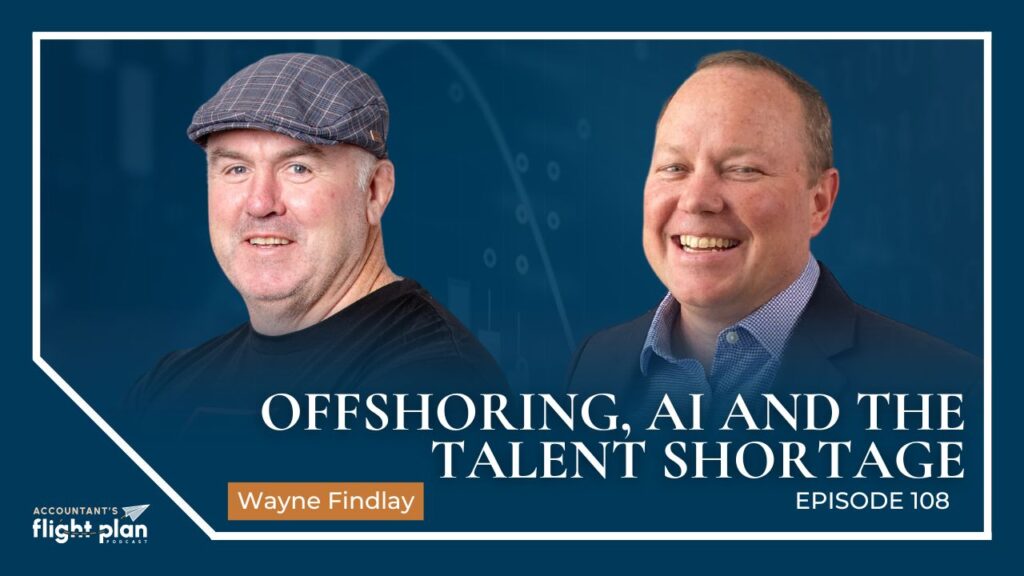
Jason Ackerman, Co-Managing Partner at BNA Advisors, helped grow the firm from a $1.5 million firm to over $7 million organically, without acquiring a single practice. He joined his father’s firm in 2012, scaled the team from 14 to 35 people, and built systems that allow the firm to handle more than 2,000 individual tax returns per year. His approach combines practical technology adoption, intentional pricing strategy, and a long view on people and talent.
This is the fifth episode in our Power of Focus series and Jason’s story is a strong example of what is possible when a firm stops trying to do everything and starts doing the right things well. This episode digs into the specific tools and tactics Jason’s team is using right now, during tax season. His firm is rolling out 8821 authorizations for every client so they can pull IRS transcripts through Tax Now, catching payment discrepancies and missed filings before they become problems. They are also using a payment platform called Remission to schedule quarterly estimated payments for clients in one place. They’re reducing the back-and-forth and keeping the firm proactive rather than reactive. Both moves are part of a broader philosophy: reduce what the client has to do, increase what the firm can see.
On the technology side, Jason is a strong advocate for best-of-breed software rather than all-in-one platforms. He was an early adopter of Karbon for practice management and has built automations that handle routine client touchpoints without manual follow-up. He also shares a measured take on AI, noting that while AI-powered bookkeeping tools are already automating 80% of transaction coding, he is watching the market carefully before committing to newer platforms.
The Conversation Covers:
- How pulling IRS transcripts proactively helps CPA firms catch payment errors before they reach the client
- Why value pricing is the single most effective lever accounting firm owners can pull to improve profitability and reduce owner hours
- How rotating staff through new client calls builds pricing literacy and business awareness across the team
- Why early software adoption with a best-of-breed mindset beats chasing every new AI tool on the market
- How the talent landscape for accounting firms is shifting post-tax season as private equity consolidation continues
The through line of this conversation is intentionality. Jason is not automating things for the sake of automation, he’s not chasing every new AI platform, and he’s not pricing low to win volume. Every decision connects back to a clear standard: does this make the practice better, or does it just add noise? That kind of focus, applied consistently over more than a decade, is how a $1.5 million firm becomes a $7 million firm without a single acquisition.
This episode is for CPA firm owners curious about building scalable systems without outside capital, practitioners ready to revisit their pricing strategy before the next season, firm managers wondering how to develop staff into more business-aware team members, and accounting practice owners thinking ahead about talent and technology in a changing industry.
TIMESTAMPS
- 00:36 – Jason Ackerman introduces BNA Advisors: $7M firm, organic growth, and co-founding a software startup
- 01:08 – Growing a CPA firm from $1.5M to $7M without acquisitions since 2012
- 02:21 – Series context: practice management tactics for tax season 2026
- 03:23 – Why tax compliance still requires real expertise despite the shift toward advisory
- 05:07 – The 8821 strategy: pulling IRS transcripts proactively for every accounting client
- 06:46 – Using Remission to schedule and track quarterly estimated tax payments
- 08:24 – The biggest operational pain points BNA solved as the firm scaled to 35 people
- 09:22 – Why Karbon became a cornerstone of BNA’s CPA firm practice management system
- 10:52 – How to approach technology adoption: change one thing at a time
- 12:15 – How Jason evaluates new software as an early adopter in the accounting industry
- 13:22 – A measured take on AI tools: waiting for the market to shake out
- 15:56 – How private equity is reshaping the accounting talent pipeline
- 27:42 – Why value pricing is the single biggest lever for CPA firm owners preparing to sell
- 29:21 – Why pricing high from the start attracts better accounting clients and protects your time
- 30:38 – Book recommendation: discussion of the Karbon co-founder book featuring BNA Advisors
BOOK RECOMMENDATION
Scale with Purpose
TRANSCRIPT
Brannon Poe (00:00): I’m Brannon Poe, and this is the Accountant’s Flight Plan podcast, where you can enjoy engaging conversations about mergers and acquisitions and accounting practice management. Listen in on strategies to build a more fun and valuable accounting firm.
Welcome to the Accountant’s Flight Plan podcast. I have a repeat guest on today, Jason Ackerman, CPA, partner at BNA Advisors. Is that the right title for you?
Jason Ackerman (00:36): Sure, sounds good, feels right.
Brannon Poe (00:38): For those that don’t know you, tell our audience a little bit about yourself.
Jason Ackerman (00:41): Yeah. So I’m a CPA. I run BNA Advisors. We’re over a $7 million accounting firm based in Rock Hill, South Carolina. I’m also a co-founder of a software startup called Welfare Abbott, because, you know, I’m not busy enough, so why not try other things? But I’ve been a CPA for 15 plus years. My dad started our practice and I came back in 2012 and we were about a $1.5 million firm at the time. From then we’ve grown completely organically, haven’t acquired anyone, up to $7 million. And we also have a wealth side.
Brannon Poe (01:08): Yeah. Full disclosure, I’m a client of Jason’s.
Jason Ackerman (01:11): Yeah, full disclosure, Brannon’s a client. You can really tell me about your experience with us.
Brannon Poe (01:15): Yeah, but it’s been great from my side. And I know you guys are really cutting edge. You do good work, and you seem to have it together in all regards.
Jason Ackerman (01:23): We try. There’s always improvements. We’re not perfect. Nobody’s perfect. I think that’s a key thing with the firm—you always have to, you can’t be complacent. You always got to be growing. You always got to be trying new things. AI is taking over. You’ve got to figure out how to use these tools to help you.
Brannon Poe (02:21): Yeah, and that’s the goal today. We’re doing a series of podcasts based on practice management this tax season. We’re recording this in early 2026. Hopefully people can have actionable ideas from this that they can use this tax season. So that’s kind of the goal of this series. One of the things I want to dive into is maybe some specific tactics that would help firm owners or managers have a better practice. So we’re going into tax season. Your tax season starts really heavy mid-February you said?
Jason Ackerman (02:51): Yeah. And I think a lot of people listening to this, tax season is just all year round now. I think it used to be more specific and it was more compliance. Everyone’s moving towards advisory now, which is good. But advisory is year-round. And I hate when people call it compliance because that makes it sound like doing a tax return isn’t hard. You can’t just hire a monkey on the side of the road to do a tax return. People don’t realize it takes a lot of time, especially to know when something’s wrong or not. So it’s a very good service to do the tax return the proper way. But there are set times for that. And I think something we’re trying to do more is tell clients it’s okay to get an extension. There are some people who just want their tax return done, but we explain, “Hey, it might make more sense to just do an extension, gives us a little more time.” So I think communication with the client is very important.
Brannon Poe (03:23): Yeah. And you guys have great clients. I think you could have a million Brannons and you’d be happy.
Jason Ackerman (03:27): Not a million. Maybe like 400.
Brannon Poe (03:30): Yeah. It helps to have, you know, I like to think our books are in pretty good order, so we’re not like one of those crazy clients.
Jason Ackerman (05:07): Yeah. So when you ask about practical things that we’re doing, I think one thing that I’m a big believer in is what can we do to make the client experience better, and what can we do to make it easier so the client doesn’t have to do as much? What do I mean by that? There’s stuff that we can get that the IRS has or the state has. Let’s get that and not have to ask the client for it.
So the IRS has transcripts you can pull for clients and you can get all their payment records and everything. And that’s good, because sometimes the client doesn’t remember if they made a payment or didn’t, and they might have made it for the wrong year or whatever. So a big thing that we’re doing for this tax season is getting 8821s for everyone. An 8821 just allows us to pull transcripts with the IRS. We’re using a software called Tax Now to pull these transcripts and it alerts us if anything happens.
So we started that process last fall and a lot of people have gotten 2848s, power of attorneys, for clients. And we’ve done that sporadically for certain clients, but we’re really doing that for every client now. So we have that in our onboarding process because I want to be able to pull transcripts. I want to be able to make sure that I know the tax return has certain things right. Most notices come from we didn’t put the payments in there right, or you paid it twice, or you paid in the wrong year. We can catch that. And that’s a value to the client if we’re like, “Hey, we realized you didn’t make this payment right. Let’s call the IRS real fast and get them to move the payment.” That’s a big value-added service and I don’t have to ask you for it. It’s happening in the background. You can charge a client more for that. So that’s one big thing we’re doing.
Another thing that we’re working on is for payments. So a big issue is if you have to make quarterly estimates, how do we know that they’re getting done? How do we remind you the proper way? How do we schedule them? So we’re using a software called Remission. They’re pretty new. They’re out of Canada but they just started in the US. And you can basically help schedule payments for federal and all the states in one software. So that way I can log in and say, “Brannon, I want to see, hey, did you make your payment? Here’s the next four quarters you need to make. I’m just going to go ahead and schedule them.” And then when we have our tax planning meeting in the summer, we might update these, but let’s just put them in here so we know and you don’t have to worry about them. You’ll get an email a week before saying, “Hey, make sure you’ve got money in your bank account.”
So I think those are two practical things that are going to help us this tax season. I’m going to be able to pull transcripts, see stuff instantaneously, and instead of me having to walk you through how to make a tax payment or making a tax payment for you on the IRS website, I just have one software to do it all.
Brannon Poe (08:24): Yeah. So software—I mean, you guys have a pretty good tech stack. What are some of the biggest, if you think back like five years, what are some of the bigger pain points your firm has experienced that you have solved in one way or another? You’re talking about these things that are more recent. Have there been bigger problems like staffing or training problems or quality issues that you’ve had to solve? What are some of the big things that you’ve had to encounter?
Jason Ackerman (08:47): I mean, yes, all of the above. I think every firm has all of these problems. I think where we, as you grow, it’s hard. You really need more processes to set up. I can’t manage 35 people. When I started we had 14 or 15. I could supervise almost all of them. So I think our biggest thing that we did almost ten years ago now is we got Karbon practice management. We were very early on in Karbon. Karbon has grown a lot now. But getting the right CRM and task management to make sure that you have a good system for tracking your projects, especially in a tax firm where we do 2,000-something individual returns a year, we have to have a good process for that and we have to have software for that.
Brannon Poe (09:22): Yeah, I think a lot of firms are using Excel or they’re using an antiquated software that’s not cloud-based or something.
Jason Ackerman (09:28): So I always tell people, the first thing is document management. Where are you having your documents? Because that’s where your documents are important. So if you’re still using a file cabinet, you’ve got to get on the cloud and you have to find the right one that works for your firm. So we use Box. That was one of the first things we did. And then the client management system Karbon was very, very big.
Brannon Poe (09:52): Yeah. And Karbon, from my perspective as a client, it’s great. I really like how easy it is. We have a good example—we have a quarterly meeting where we meet every quarter and talk about whatever we talk about. But I have that set up in Karbon automated. So the first of the quarter, it sends you an automated calendar link saying, “Hey, schedule it.” And then once you schedule it, it marks it off. That’s just a simple automation that I don’t ever have to worry about. You get it, you sign off on it, we’re good to go.
Jason Ackerman (10:22): Yeah, I think doing that type of stuff with repetitive tasks—if you’re manually doing something, there’s probably a better way to do it. And I would say if you’re just new to this thing and you’re like, “Oh, I’m so far behind,” hey, you’re not that far behind. But don’t try to change it all at once. Just pick one thing for this tax season. One thing. If it’s like, “I’m gonna do the 8821s, let’s do that.” Or “Hey, I’ve got to move from Excel to Karbon or something,” try to do one thing at a time. Because if you try to do 100, you’re going to end up nowhere.
And I like to find software that is actually going to help me. One thing we haven’t done is we have not gone with the Surepreps of the world or outsourced our tax prep because I just don’t think that it saves us time. I’m not going to do something if it’s going to cost me more time just to say I’m automating something. So I want something that will help me. And I test it. I’m kind of a tester. So if it helps me, I’m like, “Oh, it’s going to help everyone.” And then we roll it out.
Brannon Poe (11:18): So how do you evaluate different software? When you did Karbon, did you look at ten, five different softwares? Did you ask around? What’s your process for sourcing and using software?
Jason Ackerman (12:15): We’re a little different because we’re very early adopters. So I think one of my talents is that I can see if a software is going to be good. Like Karbon, when it came out, there weren’t any competitors. The competitors were the Thomsons and the CCHs and those weren’t good. So when I saw Karbon, I was like, “Okay, this is going to be good.” And I think that’s proven out over this last ten years. But yeah, so I’m a little different. I don’t test like 100 products for something. If I see it and I know it’s good, I use that and I move on.
Brannon Poe (12:42): Yeah. And then if it doesn’t work, you switch it out later.
Jason Ackerman (12:45): And I think too with AI, there’s so many new softwares out there that say they’re AI. I mean, you just put AI on anything. I Googled software and there’s a million of them. More than half of them will not be around in two years. And I think that’s where you got to be a little careful with picking a software, especially at this time.
Brannon Poe (13:03): Yeah. I noticed that at Engage, the CPA conference this summer, which you went to. I went around to all the vendors and all the booths, and everybody slapped AI on there. It’s like you got to put that on your booth.
Jason Ackerman (13:15): Yeah, it’s like we can slap AI on our booth. We use it for some things, but it’s the hype thing right now that everybody’s doing. There’s 10 or 15 K-1 AI auto makers out there. I’m kind of waiting to see which one is going to survive. Because I don’t want to change that software. Picking a tax software, a CRM—those are big softwares. And if you implement it and then it’s not working, that costs you a lot of money.
Brannon Poe (13:42): Yeah. So it’s interesting because you’re an early adopter and you’re like, “Hey, maybe wait on the AI stuff.”
Jason Ackerman (13:48): Yeah. Now there could be some—I like software and I’m a big believer in best-of-breed, not buying one thing from everybody. And I like the software that solves one thing very well. Like Remission, they just do payments, but they do payments very well. They’re not trying to build 100 things. They’re trying to do one thing. And it’s very easy to see, “Okay, this is very practical. If I get my clients on here, it will save me time. It’ll automate the process.” I get it. It’s easy to understand instead of some of these things that are like, “AI tax software.” It’s like, “Well, what does that actually do?”
Brannon Poe (14:18): No, I agree with you. A good example of that is Calendly. I mean, it’s been around for a while, but man, what a small little sliver of a tool that it is. And it’s awesome.
Jason Ackerman (14:27): Yeah, exactly. And that’s really easy to understand. Send me a link, schedule on my calendar. And there’s a bunch of other ones that come out now, but that’s their core focus and they do it really well.
Brannon Poe (14:38): Yeah. What about on the people side? What are some of the challenges and solves on that side?
Jason Ackerman (15:56): You know, as everyone knows, PE is obviously taking over accounting. And I think for us independent ones that haven’t sold out, we’re going to see—we need to hire about two people right now. But you can’t hire them if you try to hire someone in January, February for tax season. That’s not going to work. If someone wants to start then, something’s bad. People move in the tax world after tax season.
So after tax season, and I think this is really the first year—PE has been around for a little bit, but so much stuff is happening with PE—I think we’re going to see after tax season a lot of clients move and a lot of people that don’t want to work in the PE structure. So I think there’s going to be talent available. I was talking with the dean of our local college and he was talking about how PE firms recruit a lot at the campus, but they’re taking 60% less people this year because of AI.
So I think we’re going to see that there’s going to be talent out there for us to hire, maybe at a slightly discounted rate than what we’re seeing the last couple of years. I’m kind of anticipating that post-tax season.
Brannon Poe (17:18): Interesting. We’ll see. That’s prediction number one of the podcast. So we’ll see what happens. That’s the first time I’ve heard that prediction. So that’s interesting. I agree. I think there will be a fallout. I’ve mentioned on this podcast before, people who are old enough to remember back in the 1990s, American Express was rolling up CPA firms. And of course, American Express is no longer in the accounting industry. And some of the things that they ran into was they’d grow up and then they’d lose some really good talent.
I do think PE is a little smarter than that in terms of tying up the really top people in a firm when they go in for an acquisition. But I do think you’re going to see some turnover.
Jason Ackerman (17:58): Yeah, I think the partners are the top people, but then there’s that whole manager level. And that manager level, those are the ones that are getting screwed. And I think those people are the ones who are like, “Hey, I thought I could be a partner here and now there’s no partner opportunity.” And some of the PE, they’re doing different stuff too, but there’s a lot of bad PE out there. It’s kind of the wild, wild West.
I mean, I don’t know how many calls we get a day of like, “Are you ready to sell?” And it’s these 24-year-old dudes who know nothing about the accounting industry. They’re like, “Come join us.” I’m like, “You don’t know anything about accounting. How are you going to run an accounting firm?”
Brannon Poe (18:39): Did I tell you we got a visitor to our office? He was a young scout for a PE firm based in Estonia. And he was from Estonia. He spoke English, but not extremely well. And he just showed up and he wanted us to just connect him with all the firms that we have for sale. And we’re like, “It doesn’t work like that.”
Jason Ackerman (18:58): Hey, at least he came to your office. That’s nice. I mean, this guy’s got some real gumption, you know, just to fly from Estonia and start knocking on doors. Okay, you can’t make that up. From Estonia. Can you imagine someone from Estonia trying to manage a CPA firm in America?
Brannon Poe (19:14): Well, that’s what we were asking like, “How are you going to manage this?” He said, “Oh, I’ll just hire people.” I’m like, “Well, where are you going to find these people?” Exactly. The people, I can relate to this, but they have clients who are like, “I want to run my own business,” and they think they can just hire someone to run their own business. And you can’t. It doesn’t work that way.
Jason Ackerman (19:32): Yeah. We get some very interesting buyer phone calls around here. But yeah, you’ve got to keep notes. My dad always says when I retire, I’m going to do the storybook. Wait for the statute of limitations, change everyone’s names, but…
Brannon Poe (19:47): You’ve got some good ones too. We need to start keeping up with the really humorous ones. I need to start writing these down.
Jason Ackerman (19:53): Yeah, yeah.
Brannon Poe (19:55): What’s funny, when I was an auditor at EY, we had this one audit that was really long and this was before HR got really involved with how people behaved at work. We had this thing called the quote list on this audit. You know, somebody would say something that could be taken out of context. And this is why HR would probably not accept something like this nowadays. But we would take things out of context and say, “Oh, that’s going on the quote list.” And then at the end of the audit, we’d read that out to the team. They’d all have a good laugh. And then it floated around the office, the whole office.
Jason Ackerman (20:30): Yeah. You’d be fired now.
Brannon Poe (20:33): Yeah. But I could do that around here with the buyers. Some of the stuff we get. We had a guy one time, he was calling to sell a firm, and we started asking a few questions and learned that he didn’t own the firm. He was an employee and he was trying to sell his job, essentially. It doesn’t work like that.
Jason Ackerman (21:03): Oh, you know what’s funny is most accountants don’t understand how an accounting firm runs. And I think that’s the biggest thing I’ve learned from starting this. You really have to train your people on how we make money, which you’d think would be intuitive, but it’s not. They don’t understand that. They don’t understand. They’re like, “Well, I’m making $100,000 and you’re billing $300,000. Why am I not making $300,000?” Like, well, you know, there’s some costs involved and there’s a thing called profit and risk-reward.
So I think that’s something that we are trying—one other thing we’ve implemented over the last year is I used to do most of the new client calls, and we used to have one or two people do it, but now we’re kind of rotating everyone through that. And what I like about that is they learn how we price, they learn how different clients are, how we make money. So I think that’s very important to do. Make sure from very early on that they learn, “Hey, this is why we have to charge this.”
Brannon Poe (22:15): Yeah, yeah.
Brannon Poe (22:18): Well, this has been great, Jason. I think this will be helpful for people listening. Do you have anything—we can keep going a little bit. What else do you have to share that you think would be really helpful for people?
Jason Ackerman (22:30): Well, I think this tax season, obviously there was a tax law change last year. It doesn’t affect a lot of our clients because it’s mostly an extension of stuff. But there are planning opportunities like the SALT cap. I mean, it’s big. The 1202 stock if you’ve got clients that are trying to sell. So I think there’s going to be a lot more planning opportunities. There’s a new form for Trump accounts.
But one thing I think—this tax season could be a little delayed because of the new forms and getting the software to be approved because it’s got to go to the IRS, the IRS has to release this, go to the states, blah blah blah. And then the software vendors have to make sure it’s all good. So I’m anticipating a little bit of delay in when filings actually happen, but it will be interesting to see what actually happens.
Brannon Poe (23:16): Yeah. Well, any other predictions? I got to come back down in May and see what else happens. Any other predictions? The delayed prediction.
Jason Ackerman (23:26): I mean, there’s going to be an AI prediction, but I don’t know what the prediction is. Basically the question for me is when will 95% of the bookkeeping transaction coding stuff be automated, and when will 95% of the tax return be automated? And I don’t know when that’s going to happen, but I think it’s going to be sooner than we think. I think three years. Three years. So 2029.
Brannon Poe (23:51): Yeah. I’m going to take the under on that. 2028 maybe.
Jason Ackerman (23:55): Yeah. We’re already seeing—we’re more Xero people than QuickBooks people, so I can’t speak to that. But Xero just released their auto-coding feature, their AI. And I’ve been testing it and it does a very good job at it. It does like 80% now.
Brannon Poe (24:10): Oh, wow.
Jason Ackerman (24:11): But it doesn’t do the complex stuff. If you’ve got a transaction that needs to be broken out between interest and principal or stuff like that, but the base, it can do. Maybe I’m wrong. I just feel like—there’s the human adoption piece too, right?
Brannon Poe (24:25): I think, well, that’s the thing.
Jason Ackerman (24:27): For the tax side, you really got to get the tax software. Okay, here’s a prediction. This is more of a hope than a prediction. But I’m really hoping that we have a big competitor to the tax software—the CCHs, the Thomsons—that comes in that’s cloud-based, that’s automated, that’s actually very good. And I hope that will happen in the next two years.
Brannon Poe (24:50): So how about that? I like it. You got your eye on anybody in particular that’s doing that?
Jason Ackerman (24:56): No. And to be fair, I haven’t—I’m always looking but I haven’t heard of anything. But I know people are working on that. The barrier to entry has been it costs billions of dollars to build an income tax software. And that’s why the CCHs and the Thomsons, they know competitors are very hard. But I’m hoping that someone will come in and really disrupt the market there. So that’s more of a hopeful prediction.
Brannon Poe (25:23): Interesting. All right. Love it. Let me ask you one question before we go. If you’re a firm owner looking to sell in a year, what’s the best thing you can be doing right now? You can do a lot in a year. Six months, all you can do is kind of window dressing. But in a year, you could probably—what would you say?
Jason Ackerman (27:42): Pricing is the biggest lever that accountants can pull to improve the practice on paper and just in general. Pricing and switching to value pricing—that would be the thing if you were only going to focus on one thing to really move the needle, that would be it. Because what buyers are looking for, they’re looking at owner hours and how difficult the practice is to operate, and then the cash flow, the profitability. And those kind of have a way of helping you in both regards because you price yourself out from some clients. So you kind of eliminate some of the lower-end work that might not be profitable anyway. And that frees up your time and then you’re able to divert your attention more on the clients who value you and are willing to pay. So it really helps with both of those key metrics.
Brannon Poe (28:34): You do a good job of that. You’re good with that.
Jason Ackerman (28:37): I love it. I believe in it. Yeah, I think if I talked with someone who’s starting a new accounting firm, that’s the biggest thing I’d say. Price high. Don’t price low. That’s the worst thing you can do because you attract the wrong type of clients. And then they just tie you up and it takes a ton of your time and then you can’t get good. It’s not gonna work.
Brannon Poe (29:21): I haven’t done a study on this, but I’d love to. It’s like the percentage of time you spend per dollar you’re charging someone. It’s always like when we used to charge $400 or $500 for a return, those were always the ones that would ask you a thousand questions. Whereas the people who you charge $10,000, they’re busy. They don’t have time to ask you a million questions.
Jason Ackerman (29:46): Yeah, and they trust you to do your job, which is what you want.
Brannon Poe (29:50): Exactly. I love that. I want one more thing before we close off. Any good books lately that you can share with our audience? Have you read any good books or listened to any audiobooks?
Jason Ackerman (30:38): Hold on. I’m going to get—speaking of Karbon, we are featured in this book. This is from Ian Vacin and Jason Blumer. Jason Blumer is from South Carolina. We’re South Carolina people. He’s a smart person and is one of the co-founders of Karbon. And they wrote this book and we’re featured in it. And my dad has a quote. I’ll read it. This is one of his favorite quotes talking about, because we don’t keep track of time, and his quote is, “The only people who track time are inmates.” That’s literally his one quote in the book.
Brannon Poe (31:15): I love it. Your dad.
Jason Ackerman (31:17): But this is a great—it’s an easy read. I mean, how many pages is it? It’s 250 pages, but there’s pictures and other stuff. It’s a quick read. And it’s good for firm owners that are growing and having issues with growing, pain points. It kind of walks through that. So shameless plug. We endorse it from us.
Brannon Poe (31:38): But you know, I know Jason Blumer. He’s a great guy. He’s a cool dude. And he’s a thought leader for sure. All right, Jason, thank you so much.
Jason Ackerman (31:48): All right, Brannon. Happy tax season.Brannon Poe (31:51): Thanks for listening to the Accountant’s Flight Plan podcast. You can keep the momentum going by subscribing and sharing your thoughts with us. Visit our website at poegroupadvisors.com for more resources, and tune in next time for more exciting conversations like this one. This podcast was produced and edited by Liesl Eppes of Poe Group Advisors. Thanks for listening.