

Over the last several years, we have worked with an increasing number of firm owners who came to us after unsuccessful deal negotiations. Many of these breakdowns, along with the deal fatigue and unnecessary legal costs that follow, can be avoided by knowing what keeps a transaction moving and recognizing red flags early.
How Successful Deals Move
The foundation of a great deal is fit. The seller trusts the buyer, the buyer is motivated, and both believe the firm, its people, and its clients will benefit from the transition. That confidence creates optimism, mutual respect, and momentum.
In a deal that moves smoothly toward closing, offer deadlines are met, deposits are paid promptly, financing is approved, and negotiations and due diligence proceed without becoming unnecessarily burdensome. Sensitive boundaries around client information and employee interviews are also respected.
A buyer who sees a clear path to success is often more willing to pay a market-driven price. With less haggling and retrading, the transaction flows more naturally and closes more quickly.
Red Flags to Watch
Unfortunately, not every buyer who submits a strong initial offer will honor it all the way to the closing table. Some buyers make an attractive offer to secure exclusivity. Once competing offers have been waved off, the real negotiation begins.
A buyer’s true strategy is often revealed much later. If the balance of power begins to shift, you can usually recognize the warning signs before becoming too deeply invested to walk away. Watch for these deal-killing red flags:
- Deadlines are repeatedly missed, and the buyer begins controlling the timetable.
- Due diligence expands without clear progress or crosses reasonable boundaries.
- The attractive headline offer that secured exclusivity begins to erode as the price, cash at closing, or other key terms are revised.
- Financing or final approval remains uncertain.
- Legal fees continue to grow while other potential buyers lose interest.
- The time and money already invested make walking away feel harder, even as concerns about the deal or the fit continue to grow.
A Recent California Success Story
How can these problems be avoided? A recent California transaction illustrates what can happen when the right buyer is selected through a well-run process.
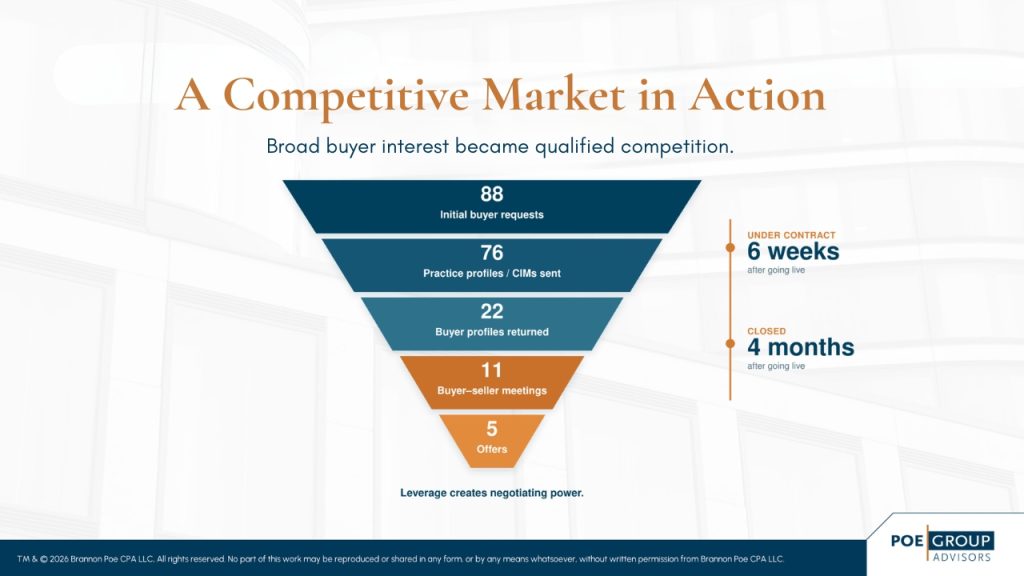
The practice attracted significant attention during the initial marketing phase, drawing more than 80 interested parties, which we carefully helped the seller evaluate and filter. The firm ultimately received five highly qualified offers, allowing the seller to select a buyer with aligned values and a compatible management style.
Both parties believed the clients and staff were positioned for a smooth transition, establishing trust early in the process. The seller felt confident about the legacy they were leaving, while the buyer recognized both the firm’s immediate value and its long-term growth potential.
The transaction moved smoothly. The buyer met every deadline, and there was no renegotiation of terms following due diligence. The necessary financial information had been thoroughly disclosed in the initial memorandum and tied directly to the firm’s tax returns.
Because the buyer saw a clear, risk-mitigated path to success, they were willing to pay a premium. The firm ultimately closed at a 10x EBITDA multiple with 90% cash at closing. It was a powerful example of how transparency, preparation, and alignment can contribute to exceptional deal terms, speed and the right fit.
Why a Full Sell-Side Process Works
Poe Group Advisors offers an investment-banking-style process backed by deep accounting industry expertise. We bring qualified buyers into a structured, competitive process.
One offer tells you what one buyer will pay. Competition creates price discovery and reveals what the market will support.
By vetting buyers, setting deadlines, and maintaining credible alternatives, we help preserve your leverage through closing. You can then choose the best combination of price, terms, fit, and certainty of close.
Choose a process built around your priorities, not the buyer’s timetable. If you are considering an offer or your current deal is losing momentum, schedule a confidential Exit Strategy Call at PoeGroupAdvisors.com/plan-your-exit.